
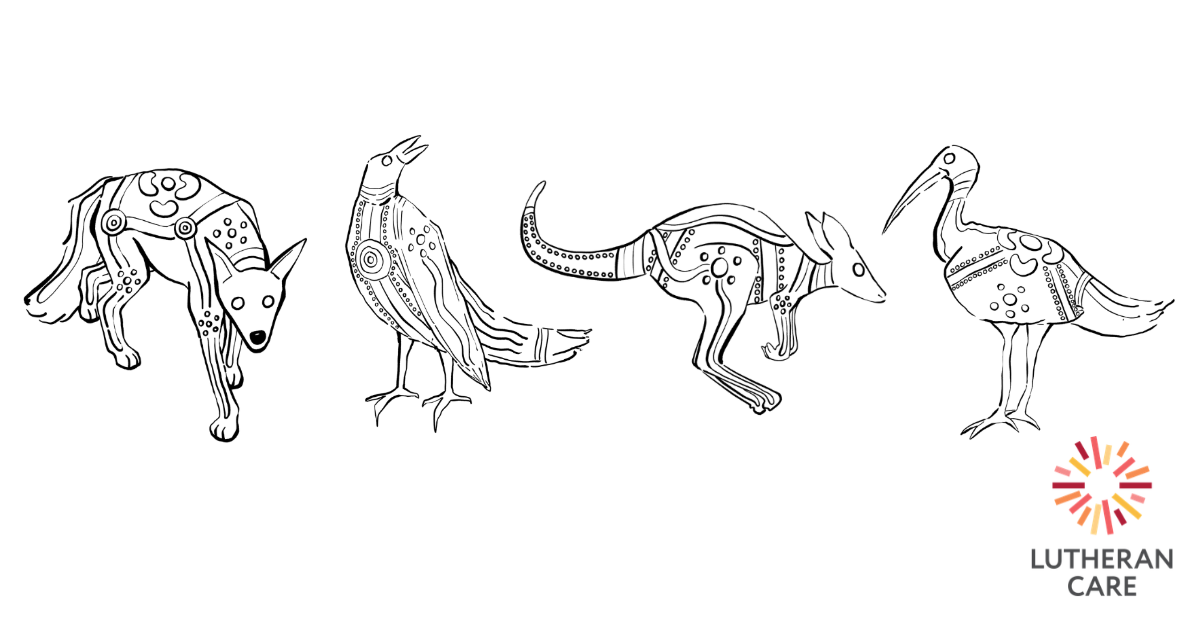
Lutheran Care’s Foster Care Family Engagement Team have partnered with Adelaide creative emerging artist Jaydenlee Tong to produce artwork that celebrates Aboriginal culture, life and stories.
Jaydenlee’s work will be used in a variety of forms for Lutheran Care’s Foster Care families, including bookmarks, temporary tattoos, banners and more, to create opportunities for foster carers to have conversations with foster children about culture, family and connection to Country.
Born in Adelaide, Jaydenlee is a Kaurna and Narungga man. As well as his Aboriginal family connections, Jaydenlee is also of Chinese and European descent. Coming from a diverse and rich background, Jaydenlee can draw on these perspectives which continue to inspire his artistic endeavours and explorations within digital mediums.
Jaydenlee explains that a big influence on his work is the ancient Aboriginal rock art and tends to refer to these paintings when creating his own artwork.
“It always amazes me to see how detailed and the techniques they use, I have tried to incorporate them in my own digital art such as the use of charcoal brushes to try and capture the hand drawn aesthetic,” Jaydenlee said.
Jaydenlee’s different cultural backgrounds have also influenced his work.
“Being also from a Chinese heritage, I can draw from experiences from my childhood to adolescence. The Chinese have specific type of artwork with ink brushes, and I love the line weight you can get using ink brushes, it isn’t rigid and it’s free. The style doesn’t focus on realism but it’s more of the feeling it invokes,” he said.
Jaydenlee has used these techniques to create these special artworks through the entire process, from conception to the finished product.
Jaydenlee explains that the artworks he created for Lutheran Care “celebrate the deep connections between Kaurna people, animals, Country and cultural storytelling.”
He added that this project is about recognising that Aboriginal culture is living and continuing.
“By sharing these designs, I hope to encourage greater understanding of Kaurna Country, respect for cultural knowledge, and meaningful conversations about the ongoing connection between Aboriginal people, their stories and the land,” Jaydenlee said.
“Each animal carries its own story, history and cultural significance, passing down knowledge and teachings across generations. These stories teach us about our relationships with one another, our responsibilities to Country and the importance of respecting the natural world.”
Lutheran Care’s Foster Care Aboriginal Engagement Worker, Andrew, said this artwork has the potential to provide Aboriginal children and young people with meaningful opportunities to connect with Country, culture and community.
“Seeing Aboriginal stories, symbols, language and cultural knowledge represented in everyday items can help strengthen a child’s sense of identity, pride and belonging,” Andrew said.
“It also creates opportunities for foster carers to have conversations with their children about culture, family and connection to Country, supporting foster children to develop a deeper understanding of who they are and where they come from.”
Lutheran Care is proud to partner with Jaydenlee and we are excited to present these beautiful artworks to the community through interactive mediums.
Jaydenlee’s artist statement for each artwork (showcased in article header image):
Tarnta — Red Kangaroo
Tarnta is connected to the Kaurna Red Kangaroo Dreaming and the creation of Tarntanya, now known as Adelaide. An ancestral creator and men’s totem, Tarnta is associated with the land around Karrawirra Pari (River Torrens), and the passing down of important cultural knowledge and sacred practices. Tarnta Kanya (Red Kangaroo Rock) is a significant place connected to this Dreaming.
Tjilbruke — Ibis
Tjilbruke is an important Kaurna ancestral creator whose story explores cultural law, family responsibility and grief. Following the death of his nephew, Kulultuwi, Tjilbruke’s journey carrying his nephew’s body is marked by tears that form freshwater springs along the coast. These significant places are connected by the Tjilbruke Dreaming Track across the Adelaide coastline and Fleurieu Peninsula. The ibis represents Tjilbruke and the enduring connection between Kaurna people, Country and cultural knowledge.
Kadli — Dingo
Kadli represents the longstanding relationship between Aboriginal people and dingoes. Traditionally, dingoes lived alongside Aboriginal families, sleeping beside people for warmth and sometimes serving as living blankets or pillows. They could also help guard camps and accompany people on hunting journeys. These relationships went beyond keeping an animal as a pet; people and dingoes lived alongside one another, reflecting a close connection between people, animals and Country.
Kuwarna — Crow
Kuwarna is connected to the Eagle and Crow story, passed down to me through my grandmother, an Aboriginal Elder. In the version shared with me, the crow was once entirely white. Following a conflict between the two birds, the eagle places a hot coal into the crow’s mouth, turning its feathers black and giving it its distinctive croaking call. The story teaches us about relationships, responsibility and the consequences of our actions. This artwork honours the cultural knowledge passed down through my family and the importance of keeping our stories alive for future generations.